
End-to-end encryption architecture
Ciforus channels are designed so message and content decryption stays tied to the communicating users, not to shared server access.
Security
Ciforus applies a custom-engineered multi-layer encryption architecture designed to protect communication, storage, identity, and account access with strong confidentiality boundaries.
Ciforus security architecture is designed to combine zero-knowledge infrastructure, end-to-end encryption channels, and user-controlled key access in one coherent privacy model.
Ciforus channels are designed so message and content decryption stays tied to the communicating users, not to shared server access.
Infrastructure is designed to process encrypted payloads without direct access to readable private content across email, messaging, notes, and storage.
Identity, key usage, and recovery flows are scoped around user control to reduce centralized access risk and credential exposure.
Traffic and stored payloads are handled in encrypted form by default, with client-side decryption boundaries maintained at the user layer.
This security model is designed around layered cryptography, segmented encrypted storage, user-scoped key derivation, and privacy-preserving access boundaries across Ciforus modules.

Ciforus uses a custom-engineered encryption module with layered cryptographic controls across transport, payload, and access layers to reduce single-point failure risk.
Per-user key material is derived into scoped keys for communication, storage, and account operations. Public/private key pairs are used for channel-level trust and secure exchange.
Recovery material uses BIP39-compatible phrase handling with hardened hashing and derivation. Binding values are used for key authorization, not plaintext phrase storage.
Private payloads are encrypted and segmented so raw database exposure does not directly provide a complete readable object without associated key context and mapping logic.
Storage services handle encrypted blobs and encrypted metadata layers, supporting confidentiality even when infrastructure components are inspected independently.
Sensitive content is designed to be decrypted in the user environment, limiting server-side plaintext handling and reducing centralized content visibility.
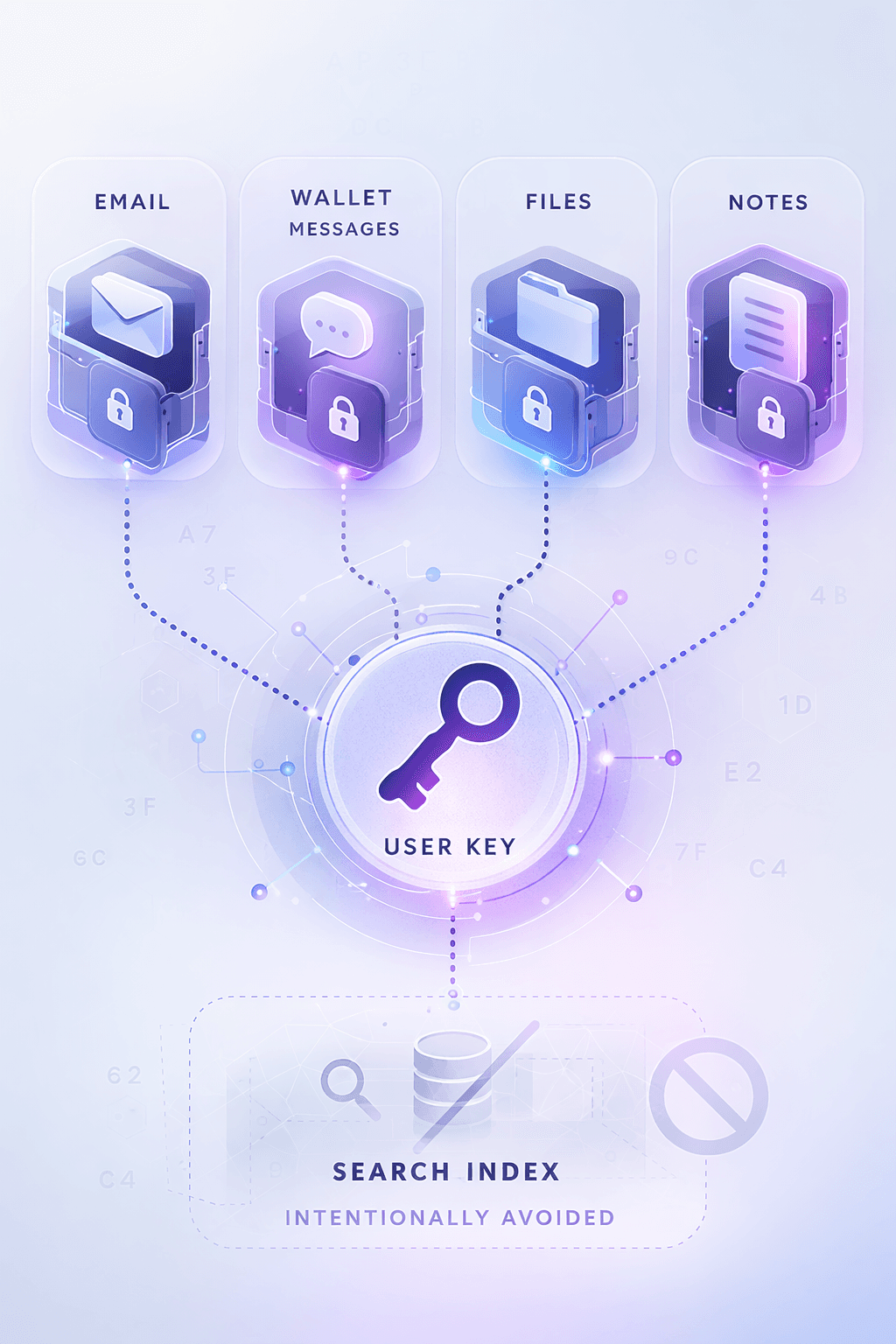
Ciforus avoids broad server-side indexing of private message bodies, file contents, and note content. This is a deliberate privacy tradeoff: full-text server search generally requires content-readable indexes that conflict with strict zero-knowledge boundaries.
Instead of optimizing for centralized content indexing, Ciforus prioritizes encrypted-by-default workflows, metadata minimization, and privacy-first data handling. The result is a system focused on confidentiality, key ownership, and reduced identity exposure across modules. So the answer is simple: if server can not read the content, it cannot index the content.
Ciforus Email is routed through a custom gateway layer that standardizes encryption-aware handling, policy enforcement, and secure transport behavior across mailbox actions.
The Ciforus Email interface is mediated through a privacy gateway layer rather than direct raw mailbox interaction paths for sensitive operations.
The gateway enforces routing, encryption handling, and security policy controls designed to keep private content outside routine server-side indexing paths.
Ciforus-to-Ciforus communication is built around end-to-end encryption principles. External provider interoperability uses standards-based encrypted transport with privacy-conscious handling.
End-to-end encryption and zero-knowledge guarantees apply to Ciforus-to-Ciforus email because both sides use the same Ciforus cryptographic protocol. External providers such as Gmail, Yahoo, Proton, and others do not natively process Ciforus-specific encrypted payloads by default, so cross-provider delivery uses interoperable email standards with strong transport security instead. This is a protocol-compatibility constraint, not a design flaw.
Strong privacy systems depend on more than encryption alone. Ciforus combines authentication controls, recovery architecture, and identity verification to reduce unauthorized access paths while preserving user control.
This includes security controls such as wallet verification, recovery-path protection, and account-level defense workflows. The architecture is designed to align cryptographic protection with practical account security for high-sensitivity use cases.
Public pages describe the implemented design direction of Ciforus security architecture. Hardening, verification workflows, and release-readiness work continue across the platform before full public launch.
Explore the product modules that connect communication, encrypted storage, wallet identity, and account protection into one privacy-focused environment.
Encryption is the foundation of digital privacy. Here is the plain-language model used by most modern secure platforms.
Encryption converts readable data into unreadable ciphertext so only a valid key can restore the original content.
In transit encryption protects data while it moves over networks. At rest encryption protects stored data. End-to-end encryption protects content from sender to recipient.
Security depends on who controls decryption keys. If keys are user-controlled, platform-side content exposure is reduced.
Ciforus is designed around recognized cryptographic foundations and practical interoperability constraints used across the security industry.
AES (NIST FIPS 197)
AES-128/192/256 is a global standard block cipher used to protect stored and transmitted data.
TLS 1.3 (RFC 8446)
TLS 1.3 protects data in transit against interception and tampering across modern internet connections.
OpenPGP for email interoperability
OpenPGP is a common end-to-end encryption model for email interoperability when both sides support compatible key exchange.
References: NIST FIPS 197 (AES), IETF RFC 8446 (TLS 1.3), Google Workspace encryption documentation, Yahoo security pages, and Proton encryption documentation.
Google, Yahoo, and Proton all provide important security controls. Ciforus uses a different privacy boundary focused on reducing identity and content exposure across all modules.
| Platform | Typical encryption model | Practical implication |
|---|---|---|
| Google services (Gmail, Drive, Keep) | Strong default encryption in transit and at rest. Client-side encryption is available for specific Google Workspace products and supported editions. | Default experiences prioritize compatibility and search-rich workflows. Encryption behavior can vary by product, edition, and admin policy configuration. |
| Yahoo Mail | Uses HTTPS/TLS transport security and modern account security controls such as OAuth-based flows. | Focus is secure transport and account protection. A native mailbox-wide end-to-end model is not the default user experience. |
| Proton | Strong privacy model with end-to-end encryption between Proton users and zero-access storage protections. | External interoperability may require PGP or password-protected flows for true end-to-end behavior outside the Proton ecosystem. |
| Ciforus internal encryption module | Custom multi-layer encryption design with user-specific key hierarchy, encrypted fragmentation, BIP39-based binding flows, and browser-side decryption boundaries. | Ciforus prioritizes privacy boundaries across modules, including deliberate limits on broad server-side content indexing. |
Ciforus is designed so communication, storage, notes, identity, and account protection follow one internal security language rather than separate per-product policies. This is where Ciforus can deliver a stronger privacy experience for users who prioritize data sovereignty over convenience-first indexing.
This comparison focuses on privacy-boundary design choices and is not a claim that other providers are insecure.